Lead is the defining material of Chichester's historic roofscape. The flashings on Cathedral Close properties, the valley linings on Georgian townhouses, the chimney soakers on Victorian terraces — all lead, all requiring a specialist who understands the material and the conservation context. We carry out leadwork across all of Chichester to Lead Sheet Association standards.
Tell us the job in 30 seconds. No pushy sales, no call-out fee.
📞 Call Now: 01243 278085Leadwork in Chichester covers chimney flashings (£350–£750), valleys (£400–£900) and flat lead, to Lead Sheet Association standards. Harbour-adjacent properties get patination oil as standard. Free survey, no call-out fee. Call 01243 278085. Covering Chichester, the harbour villages and surrounding West Sussex.
Chichester has more lead roofing per square mile than almost any town in the South East. The historic core — the Cathedral, the Georgian streets, the Victorian terraces — is built on a tradition of high-quality leadwork that defines the character of the roofscape. When this lead fails, like-for-like replacement in the correct code and specification is the only appropriate response. No modern substitutes.
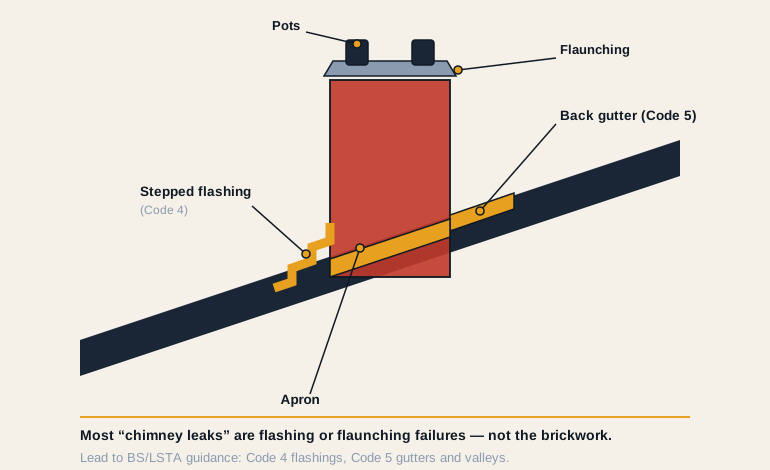
Chimney flashing failure is the most frequent lead-related call we receive across Chichester. The lead apron at the front of the chimney stack, the soakers between the tiles and the stack, and the back gutter behind the stack all deteriorate over time — lifted by thermal movement, corroded by atmospheric sulphates, or simply worn thin after 50 to 80 years in service. On Chichester's Victorian and Georgian properties, the original lead was installed with a craftsmanship that has lasted well, but most of it is now at or past the point where like-for-like replacement rather than patching is the right call. We use Code 4 lead as standard and Code 5 on more exposed or heavily-loaded applications.
Valley linings fail before most other lead elements because they carry the highest volume of water. A blocked or deteriorated valley on a Chichester property — particularly one with heavy tree canopy above — rapidly backs up water under adjacent tiles. We replace lead valleys with correctly dressed Code 4 or Code 5 lead, sized and lapped to the Lead Sheet Association's current code, with proper falls and no joints in the running length where avoidable. On conservation area and listed building properties, lead is the only acceptable valley material — no GRP or aluminium alternatives.
Free survey — no call-out fee — Chichester & West Sussex
📞 01243 278085Many of the commercial and ecclesiastical buildings in Chichester city centre have flat lead roof sections — bay roofs, parapet gutters, and small flat areas between roof sections. Flat lead requires careful specification: sheet size, bay length, drip edge details and expansion provision all affect lifespan. Incorrectly specified flat lead splits at the drips or at the welted seams within a few years. We survey flat lead sections and advise on whether the existing installation is correctly specified before recommending repair or replacement.
Properties close to Chichester Harbour — in Fishbourne, Bosham, Emsworth and the coastal villages — require marine-grade patination oil applied to all new lead work. The salt aerosol in this environment attacks un-patinated lead significantly faster than inland sites. We specify patination oil as standard on all leadwork within a mile of the harbour, and advise on it for any property in the wider coastal belt.
"Lead valley had been leaking for months. Replaced properly with correctly sized Code 5 lead. Not a drop since and the craftsmanship is noticeably better than the original."
"Chimney flashing on a listed property near the Cathedral. They understood the specification required and carried out the work to the correct standard without needing to be told twice."
"Bosham quayside cottage. They specified patination oil without being asked — that told me immediately they knew what they were doing for a harbour property."
Lead failures in Chichester show at junctions — chimney flashings, valleys, bay and dormer tops — where old, fatigued or badly-formed lead lets water track in.
When it is not the answer: If the underlying covering is sound and the problem is localised, a targeted repair is the honest answer rather than a larger job. Read the full guide.
We inspect the roof at close range and diagnose the actual issue on your Chichester property.
You receive a written, itemised quote with no call-out fee and no obligation.
We book a time that suits you, with weather margin built in.
We carry out the work in materials matched and correct for the property.
We clear the site and hand over the written 10-year workmanship guarantee.
| Job | Typical duration |
|---|---|
| Minor works | A few hours |
| Typical job | 1 day |
| Larger works | 2–3 days |
Wet or high-wind days can pause work at height — we build weather margin into every Chichester booking.
Access is by tower, ladder or scaffold depending on the job and the property; scaffold is always itemised in the written quote. Scaffold is specified for: any job needing safe standing time at height - always itemised in your written quote, never a hidden extra, and we arrange it.
The Georgian streets inside the city walls — The Pallants, the Cathedral Close, Little London — mean tight access and permit-controlled pavement space, with conservation constraints on visible scaffold. Pavement scaffold and skip permits go through Chichester District Council; allow a few working days on streets like The Pallants, North Pallant, Little London where space is tight.
| Job | Typical range | Notes |
|---|---|---|
| Slipped or cracked tile refix | £150–£250 | Per visit incl. access |
| Lead flashing renewal | £350–£750 | Chimney or abutment |
| Valley lining replacement | £400–£900 | Common on tree-shaded roofs |
| Ridge re-bed (per metre) | £40–£70 | Lime mortar on period stock |
| Chimney repointing | £350–£900 | Per stack, by scope |
Worked example: A rear valley rebuild on a 1930s Summersdale semi: around £680 including tower access and waste removal.
No deposit on repairs under £500. You never pay before the work is done and inspected. Re-roofing over £5,000 is staged — nothing up front before materials are on site. Reduced 5% VAT usually applies to re-roofs; confirmed in writing.
Covering PO18, PO19, PO20 and surrounding postcodes.
Workmanship is covered for 10 years in writing, with manufacturer warranties on any materials on top.
If a fault appears in covered work, we come back and put it right. No quibbling, no re-charge.
We keep disruption to a minimum, protect the area below the work, and clear everything before we leave. You do not need to stay home for external work - we just need power and access agreed in advance.
Most work runs year-round; temporary weatherproofing goes on the same day if rain interrupts. Chichester's coastal-plain position brings salt-laden south-westerlies and harbour humidity that slow drying times.
Correctly specified and installed lead flashings typically last 50 to 80 years. In Chichester's coastal and harbour-adjacent locations, the lower end of that range is more realistic without patination oil. Most flashing failures we see are on lead that is 40 to 60 years old — either the lead itself has thinned through weathering or the mechanical fixings have corroded.
Code 4 lead (1.80mm) is the standard specification for chimney flashings on residential properties. Code 5 (2.24mm) is used on more exposed locations, flat sections carrying higher water volumes, and any application on conservation area or listed building properties where a higher specification is appropriate. We advise on the correct code for each application.
Yes, on properties in the harbour-adjacent and coastal belt — which includes Fishbourne, Bosham, Emsworth, Pagham, Selsey and properties within a mile of the harbour. We apply patination oil as standard on these sites. On inland Chichester properties it is good practice and we recommend it.
Small sections can sometimes be patched with lead welding where the main body of the flashing is still sound. Where the lead has thinned significantly through weathering, where it has lifted from the masonry, or where the existing installation is undersized for the application, full replacement gives a far better long-term outcome than patching over failing material.
Yes. Lead is the only acceptable flashing and valley material on conservation area and listed building properties in Chichester. No modern substitute materials — aluminium, GRP, lead-effect products — are acceptable on these buildings. We use lead throughout and do not offer alternatives on heritage properties.
Damp patches on ceilings directly below valley positions, staining on the valley tiles, and visible gaps or splits in the lead surface are all indicators. Valley failures often present internally before they are visible externally — do not wait for an obvious external defect before investigating a suspected valley leak.
Yes. All our leadwork is carried out in accordance with the Lead Sheet Association's current technical guidance — the industry standard for lead roofing in the UK. This covers material specification, bay sizing, fixing methods and jointing details.
For property managers and homeowners with multiple Chichester properties, a planned lead inspection and maintenance programme is more cost-effective than reactive response. Lead that is inspected every 5 years and attended to when minor issues appear — a fixing that has lifted, a joint that is beginning to open — lasts significantly longer than lead that is left until it fails and causes water damage. We carry out planned lead inspections across property portfolios in the Chichester area, providing written condition reports with condition ratings and a priority-ordered maintenance schedule. This approach converts unpredictable emergency expenditure into planned maintenance cost at a lower total spend. Contact us to discuss a planned maintenance arrangement for your property or portfolio.
Honest pricing from a local Chichester specialist. Free survey, written quote, no obligation.
01243 278085 ✉ Email Us InsteadWorking on a listed or conservation property? See heritage roofing for our full conservation service.