Roof Repairs
Roof Repairs in Chichester
Chichester's roofing repair calls follow predictable patterns tied to the city's housing eras. On Victorian and Edwardian terraces across St Pancras and Whyke Road, the most frequent jobs are clay plain tile re-laying — where mortar bedding has failed or individual tiles have slipped — and lead flashing replacement around chimney stacks where salt air has accelerated deterioration of the lead folds.
On the 1930s semis of Summersdale, ridge tile re-bedding is the most common call. The original sand and cement ridge bedding cracks under frost cycles and seasonal movement, allowing water into the ridge line. On 1960s Portfield estates, nail-sick concrete interlocking tiles begin sliding before any other visible failure appears — we see this every autumn.
Repairs We Carry Out Regularly
- Clay plain tile replacement and re-laying (Victorian, Edwardian and pre-war stock)
- Welsh and natural slate repairs and matching
- Ridge tile re-bedding and mortar repointing
- Lead valley lining replacement
- Chimney flashing strip and re-dress
- Flat roof patch repairs (GRP, EPDM, felt)
- Verge and soffit repairs
Typical Repair Costs in Chichester
Tile replacements: £150–£350 · Ridge re-bedding (per section): £200–£450 · Lead flashing replacement: £300–£700 · Valley reline: £400–£900 · All prices include materials. Free quotes on all work.
In Depth
What Do You Need to Know?
The Most Common Roof Repairs in Chichester
After 20 years of repair work across Chichester, the pattern is consistent. On pre-war clay plain tile properties — the Victorian terraces of St Pancras and Whyke, the Edwardian semis of Stockbridge and Summersdale — the most frequent calls are slipped or broken tiles, failed ridge bedding, and lead flashing failure at chimney and valley positions. On post-war concrete tile estates in Portfield, Donnington and Tangmere, nail sickness is the primary driver of individual tile loss, and ridge mortar failure is near-universal on properties that have not had recent attention. On coastal properties from Fishbourne to Selsey, the salt air adds an accelerated corrosion dimension to all metal fixings and lead work that shortens maintenance intervals compared to inland equivalents.
How We Diagnose Roof Repairs in Chichester
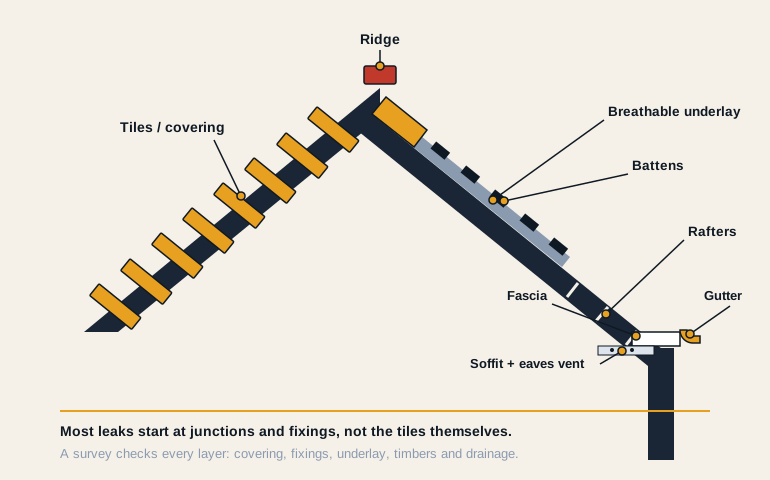
Most roof repair calls start with a symptom: a damp patch on a ceiling, a tile visible in the garden after a storm, water running down a wall. The symptom and the defect are frequently in different locations. Water that appears on a bedroom ceiling may be entering through a failed valley or open ridge 3 metres away and running along a rafter before dripping. A damp patch on a chimney breast is almost always a flashing failure — not the pointing — even if the pointing looks open. We diagnose from close range: a ladder inspection of all four elevations, valley and ridge inspection, and loft access where available. We tell you what is actually causing the problem, not what is easiest to fix.
Free survey — no call-out fee — Chichester & West Sussex
📞 01243 278085
Matching Materials on Chichester Period Properties
Getting the material specification right on a repair is as important as the repair itself. A concrete tile replacement on a Victorian clay plain tile terrace in St Pancras is immediately visible and architecturally wrong. An incorrect slate profile on a Welsh slate roof in Whyke stands out from the pavement. We carry matching clay plain tiles in the most common Chichester profiles and source reclaimed tiles through suppliers with graded stock for colour matching on conservation area and listed building properties. For Welsh slate, we source natural slate in the appropriate quality and profile. We will tell you at the survey whether a close match is achievable, and show you options if it is not straightforward.
Pricing and What Drives Cost on Chichester Roof Repairs
The main variables in roof repair pricing are access, scope and materials. Access is often the largest cost component: a single tile replacement on a two-storey property requires a ladder and typically 30 minutes of work; the same repair on an inaccessible valley position may require scaffold. Scope matters because what looks like a small repair on one tile frequently reveals additional deterioration when inspected close-range. We always survey before quoting — a phone quote on a roof repair is a guess. Materials matter on period properties where matched tiles or reclaimed slate cost more than standard stock. Our quotes are itemised: access costs, material costs and labour costs are shown separately so you can see exactly what you are paying for.
Repair or Replace: How We Make the Call
We do not recommend roof replacement when repairs are the right answer — it is not in our long-term interest to oversell work. The replacement conversation starts when isolated failures become a pattern: when the repair bill for the year approaches £1,000 and the roof is still generating calls. When nail sickness affects more than one pitch. When a survey reveals that the felt underlay — the last line of defence against water ingress — is deteriorating and would require a full strip to access and replace. At that point, the comparison is between continued reactive spending and a one-time investment that resets the maintenance clock to zero. We give you the honest numbers and let you make the decision.
What Happens If We Find More Than Expected
Roof repairs occasionally reveal more than the initial symptom suggested. A slipped tile can expose deteriorated felt below. A lead flashing replacement reveals open mortar joints in the chimney above. A valley repair uncovers rotten timber beneath. When this happens on a Chichester property, we stop, photograph what we have found, and call you before proceeding. We will give you a clear explanation of what we have found, what the options are, and what the cost implications are. We do not carry out work beyond the agreed scope without your explicit approval. If the additional work is minor and you authorise it verbally on the day, we confirm it in writing afterwards. No surprises on the invoice.
Finding a Reliable Roofer for Repairs in Chichester
Roof repairs attract a disproportionate number of unreliable operators — particularly after storm events when demand peaks and less scrupulous traders chase it. The tell-tale signs of a poor operator in Chichester: knocking on the door claiming to have spotted damage from the street, asking for large cash deposits before work starts, providing a verbal quote only with no written breakdown, and refusing to provide proof of public liability insurance. We do not cold call. We quote in writing. We ask for no deposit on repair work under £500. And we carry £5m public liability insurance that we are happy to show on request. NFRC registration — verifiable at nfrc.co.uk — means we have been assessed against recognised industry standards for quality and professionalism.
Preparing for a Roof Repair Survey in Chichester
To make the most of a roof repair survey, it is helpful to have a rough idea of when the symptoms started and whether they are getting worse. A damp patch that appeared after a specific storm is more likely to be storm-related tile or flashing failure. A damp patch that has been slowly spreading over two or three years is more likely to be gradual deterioration — mortar failure, a slowly lifting flashing, or felt that has reached the end of its life. If you have had any previous roof work carried out, knowing when and by whom is useful context. Loft access is valuable if safe and practical — close-range inspection of the felt underside and timber condition from inside the roof space often reveals things that cannot be seen from outside. We do not require you to prepare anything for the survey — we carry out a thorough inspection regardless — but any information you have about the history of the roof helps us reach an accurate diagnosis faster.